
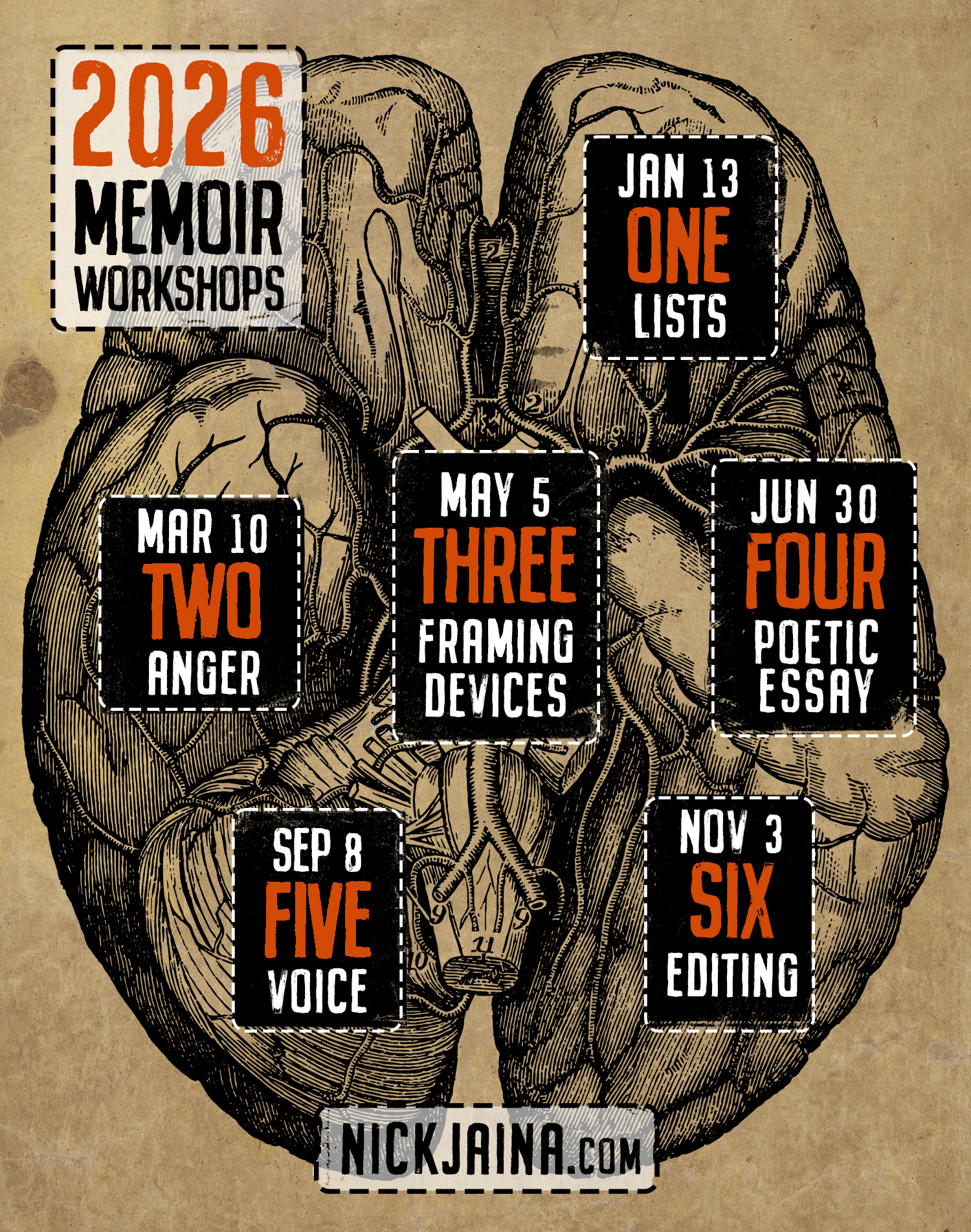
2026 Memoir Workshops
Come take a journey through memoir! I will be facilitating six units of my memoir workshop in 2026.
Each unit of this workshop focuses on a different area of writing that has been useful to me. The ideas and exercises I talk about in these classes are all generated from my actual creative process. I would never ask someone to do something just because it sounds clever if it’s not an actual method that works for me.
This is the perfect type of workshop for developing your story, processing the complicated emotions around your life, meeting other writers engaged in similar work, and moving forward with new tools to make your writing compelling.
WHAT EACH UNIT OF THIS WORKSHOP CONTAINS
• A one hour Zoom meeting on Tuesday evening each week for six weeks.
• A discussion of an important aspect of writing, including a colorful slideshow.
• An assignment to be worked on through the week and turned in by Sunday night.
• Discussion of how the previous assignment went.
• Access to the Wet Ink portal for our class, which includes the assignments, recordings of the classes, and a place where students can give and receive feedback.
• One of the unique aspects of these workshops is that I participate as a student too. I tackle the assignment along with everyone else, and that keeps me connected to the struggle.
PRICING
(A unit = one six-week class)
One Unit: $275
Two Units: $500 (250/ class)
Three Units: $700 (233/class)
Six Units: Early Registration Special $1,200
Need a payment plan? Write me at nickjaina@gmail.com
MEMOIR UNIT ONE // LISTS
I like to start the year off with a very approachable subject, especially for people who are beginning their memoir writing or jumping back into it.

Nothing could be easier than making a list:
Think of something.
Write it down.
If you have more to say about it, do so.
When you run out of things to say, move to the next item on the list.
Most pieces of writing start out with lists, and if we think of them as creative projects in themselves, we can get a lot out of the process of writing them. They can even become literary on their own.
CLASS TIMES
EARLY Class - 4:00PM PT
MIDDLE Class - 5:30PM PT
CLASS DATES
Jan 13
Jan 20
Jan 27
Feb 3
Feb 10
Feb 17
MEMOIR UNIT TWO // ANGER
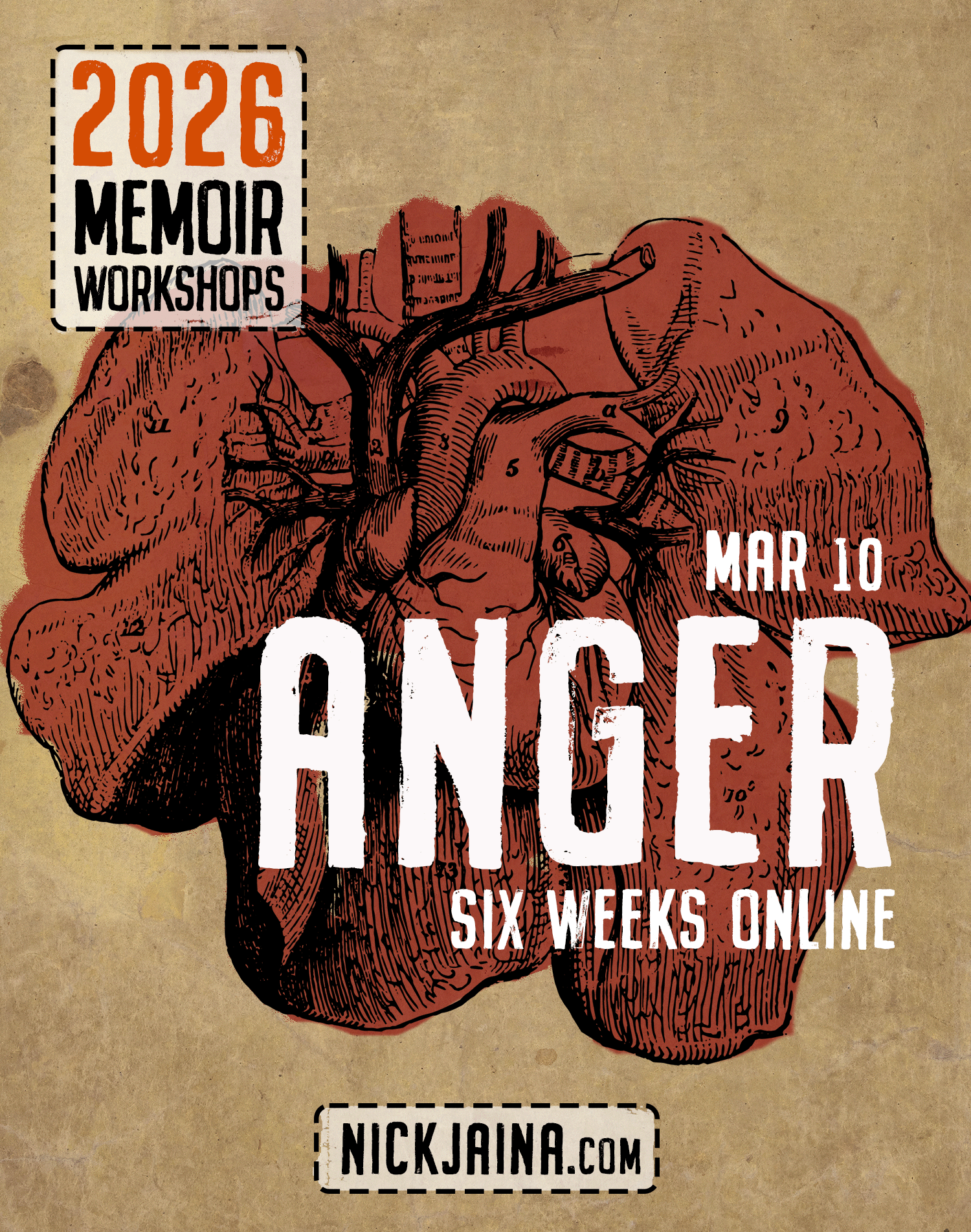
My theory about writer’s block is that it mostly happens when a writer is feeling an emotion very strongly, but they’ve told themselves it’s not okay to express that emotion. It’s really hard to write something honest when you’re suppressing something.
The problem is that it seems like if we unleash our anger, it will overtake everything. We don’t want to be seen as ranting writers adding to the discord of the world, so we bottle that anger up. This creates a contradiction within our bodies that can lead us to write nothing at all. Maybe there’s something really valuable underneath that anger? Maybe the anger is just the cork holding back something sweet.
We can only figure that out if we give ourselves the room to write with our anger, and see where it goes.
CLASS TIMES
EARLY Class - 4:00PM PT
MIDDLE Class - 5:30PM PT
CLASS DATES
Mar 10
Mar 17
Mar 24
Mar 31
Apr 7
Apr 14
MEMOIR UNIT THREE // FRAMING DEVICES
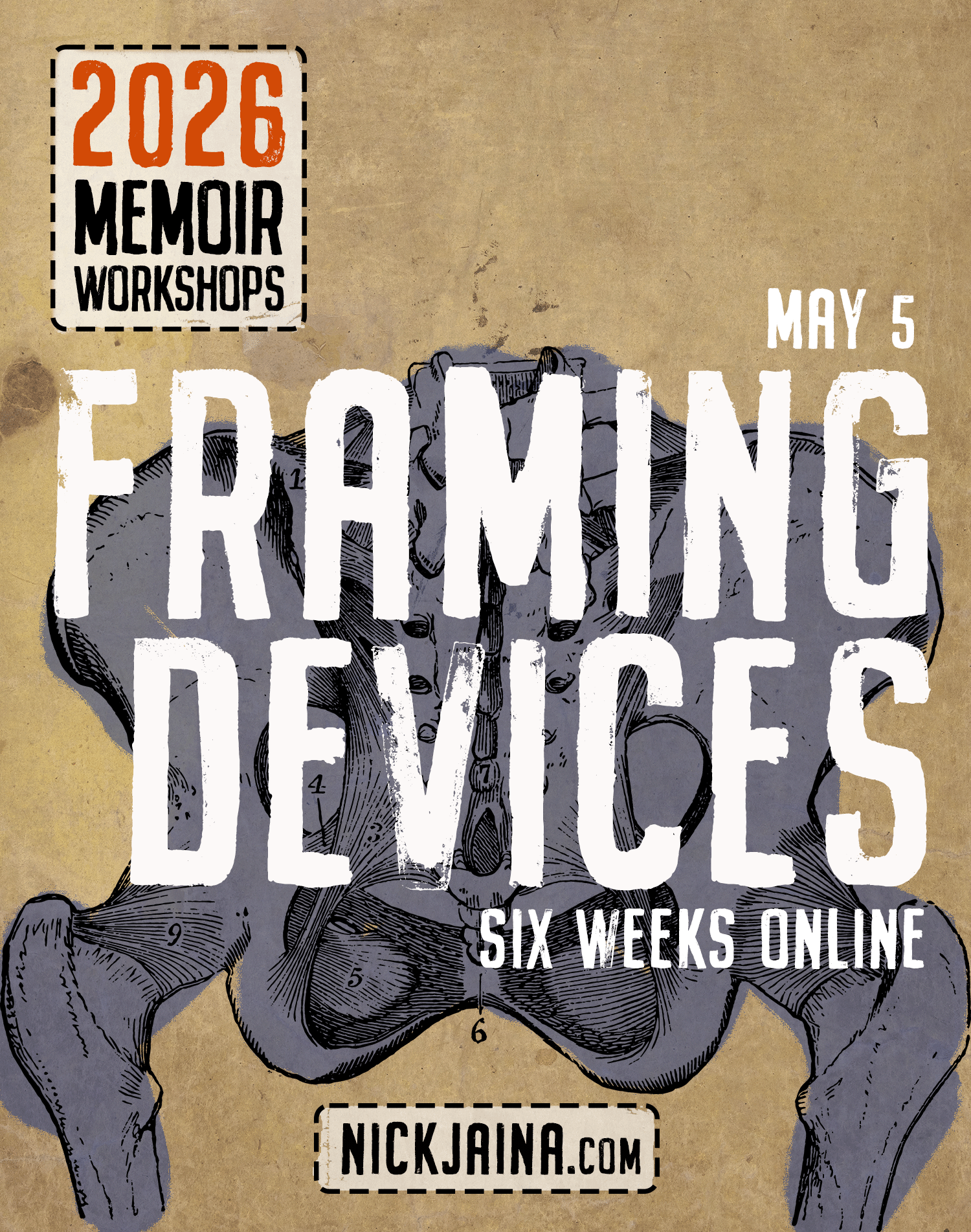
I’m fascinated by the different ways a piece of writing can have an impact on a reader depending on how it’s presented. Let’s say you’ve written a poem. Consider the following ways of presenting that poem:
#1: The poem in a book of poetry.
#2: The poem as an interlude in a memoir.
#3: The poem broken apart and interspersed throughout a memoir without identifying it as poetry.
#4: A story in a memoir where the poem is recited.
#5: A memoir that cites the poem and then offers a critique of it.
Already we see four simple approaches of how to present a poem to a reader. Normally we think #1 is the most effective way to do it, and maybe we even think it’s the only way it’s allowed. But creative opportunities open up when we consider different framing devices.
Let’s talk about the best way to frame stories, to frame specific types of writing, and even to frame different voices in our writing. It can completely transform the story we’re telling, and the good news is it can help pull a lot of existing writing into our story that we previously thought didn’t fit.
CLASS TIMES
EARLY Class - 4:00PM PT
MIDDLE Class - 5:30PM PT
CLASS DATES
May 5
May 12
May 19
May 26
Jun 2
Jun 9
MEMOIR UNIT FOUR // POETIC ESSAY
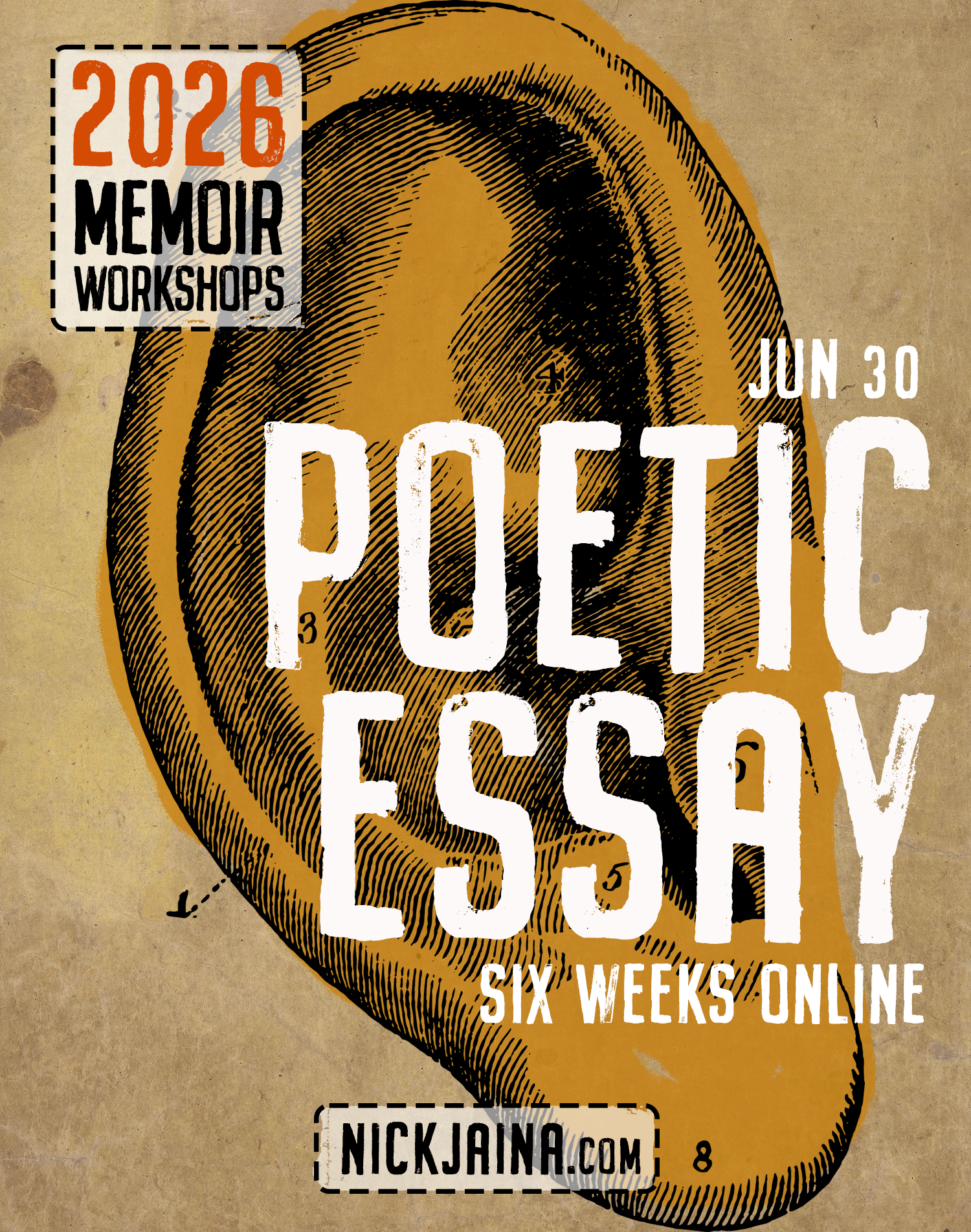
Poetic essay is a way to prioritize imagery and voice over a narrative story. This can be a good option for people who don’t have a clear arc in their life that they want to write about. Often our lives feel like a panoply of episodes, and what sticks out is the feeling of them more than anything. Accepting that reality can open up some really wonderful opportunities in our writing. Opportunities to shrink the aperture and focus on smaller things, and also to bring more reverence to the non-linear way our lives have unfolded.
Let’s explore how to focus on a poetic voice to present the essence of our lives.
MEMOIR UNIT FIVE // VOICE

Voice is a slippery thing to try to identify in writing. You know it when you see it. A writer’s voice might even be the number one thing that draws us to read someone’s writing, and to want to read everything they’ve ever written. A great writing voice makes us feel like we know the writer and that reading their book is like hanging out with them. That can be a really intoxicating experience.
It’s hard to build a class unit around such an integral but almost invisible thing, which is why I’ve often avoided talking about it. Voice… just do it! But at the same time, one of the most common questions I get is essentially “How do I improve my writing voice?”
Some people might even say either you have a writing voice or you don’t, and there’s nothing about it that’s learnable. But I think everything is learnable in writing. We just need to stretch ourselves, and maybe even do some non-writing things in real life that help us learn how to express ourselves bette on the page. Regardless, this development is not going to happen if we don’t try.
So let’s work on developing our writing voice.
CLASS TIMES
EARLY Class - 4:00PM PT
MIDDLE Class - 5:30PM PT
CLASS DATES
Sep 8
Sep 15
Sep 22
Sep 29
Oct 6
Oct 13
MEMOIR UNIT SIX // EDITING
Most of the writers that I see come through my workshops never get to a second draft of their writing. Usually they only associate editing with academic writing and don’t know how to approach it in their personal creative writing.
Editing is essential to finishing a piece of writing. There is just no way around it. I know that it can be very emotional to look at something we’ve written and try to assess how good it is. A flood of emotions can cause us to just close the file and never look at it again. But, again, it has to be done.
I think that, if we are cognizant of the pitfalls, and if we have support in the process, the editing stage can be full of creativity. You might even call it “fun,” as some of my students have started to do. It is fun. It’s still a part of the creative process, and any of the things that we associate with generative writing can still be done in the editing phase.
CLASS DATES
Nov 3
Nov 10
Nov 17
Nov 24
Dec 8
Dec 15

Hello, my name is Nick. I've written three books, I've taught dozens of writing workshops, I've edited manuscripts, and I've coached writers one-on-one. In all that work, I've come across hundreds of writers, and I've learned some things everyone has in common:
1. Everyone knows more or less what they want to write about.
2. Everyone is afraid to write those things.
To the first one, I say, “Great!” To the second, I say, “Let’s deal with those fears!”
I do these writing workshops because I get to see people when they dive into those fears and write what they’ve been wanting to write. And there is something special about gathering with a small group of people every week to write.
Here’s what I’ve seen writers get out of these workshops:
Morale
You feel good about the things you're writing because someone says, "Wow! I can relate to that."
Accountability
You feel how much it matters that you write, because there is a deadline to finish it and a group of people will be looking at you on a Zoom call.
Momentum
Six weeks of writing gives you a sense of what it's like to be in the habit of writing.
I believe that these workshops work best when the teacher is working on the same assignments as the students. That way I can provide examples of how I approach the problem, and walk through my solutions with the class. You don’t have to start at Unit One. You can join us in any unit throughout the year.
Frequently Asked Questions
Q: Do you have to start with Unit One or can I jump in on Unit Three or something?
A: You can jump in at any time! Just sign up for the unit you can do. You won’t be lost or behind. Every unit comes with a fair amount of orientation for new students and even for people who haven’t written in a while.
Q: I don’t know, is this for me? I’m not actually a writer, even though I burn with a desire to tell my personal story of love and loss and I can’t sleep at night because I feel like I’ll never be able to write it.
A: Hmm… You sound like a writer to me! Come join the class!
Q: How many people are in the workshops?
A: My ideal number is ten people, because it feels like the perfect balance of group inspiration but you can still have your voice heard. Sometimes it’s a little smaller or bigger depending on the vagaries of human availability, but trust me, whatever number it is, it’ll be the right number.
Q: So, a one hour video meeting every week, and then we get an assignment, and we have to turn that in before the next class?
A: That’s it! You seem to know this as well as I do. Have you been in this class before?
Q. No, no, of course not. I’m a writer, so I observe and make good educated guesses.
A: Get in this workshop already!
If you have any more questions about the workshops, write to me at:
nickjaina (at) gmail (dot) com